
 русский
  عربي
عربي  Español
 Português
 日本語
日本語 한국어
한국어 Français
 Deutsch
 ไทย
ไทย Indonesia
 Việt Nam
 Türkçe
 O'zbek
 简体中文
简体中文 Italiano
 Čeština
 Eesti
Eesti Gaeilgenah Éireann
 Bai Miaowen
 íslenska
 Cymraeg
 Български
 اردو
اردو Polski
 hrvatski
 українська
 bosanski
 فارسی
فارسی Lietuvių
 Latviešu
 עברית
עברית România limbi
 Ελληνικά
 dansk
dansk magyar
 Norsk
Norsk suomi
suomi Nederlands
 Svenska
 slovenčina
 slovenščina
 हिंदी
हिंदी Melayu
 Malti
Malti Kreyòl Ayisyen
 Català
 বাংলা
বাংলা Srbija jezik (latinica)


Energy Efficient 3-Phase Induction Motor
What is a three-phase induction motor?
The three-phase induction motor is an efficient, reliable and durable electric motor widely used in the industrial field. This motor generates a rotating magnetic field through three-phase alternating current, which drives the rotor to rotate and converts electrical energy into mechanical energy. Its main features include high starting torque, low maintenance requirements and long life, suitable for various industrial applications such as pumps, fans, compressors and conveyor systems. The three-phase induction motor has a simple structure and usually consists of a stator, a rotor and a housing. It can operate stably in harsh environments and reduce equipment failures and downtime. Its high efficiency also makes it excellent in energy conservation and emission reduction, and it is an indispensable and important product in modern industrial equipment.

Construction of Three-Phase Induction Motor
The three-phase induction motor is widely used in industrial applications due to its simple and strong structure. It mainly consists of two parts: stator and roto
1. Stator
The stator is the fixed part of the motor and mainly includes the following three parts:
Stator frame: This is the external structure of the motor, which provides support and protection for the stator core and stator winding. The outer surface of the frame is usually provided with heat sinks to help dissipate heat and cool. Depending on the size and purpose of the motor, the stator frame can be made of materials such as cast steel, machined steel, aluminum/aluminum alloy or stainless steel.
Stator core: It is composed of stacked silicon steel sheets and is used to conduct magnetic flux and improve motor efficiency.
Stator winding: It is embedded in the slots of the stator core and generates a rotating magnetic field through three-phase alternating current to drive the rotation of the rotor.
2. Rotor
The rotor is the rotating part of the motor, which is installed inside the stator and supported by bearings to achieve smooth rotation. The structure of the rotor is generally divided into two types: cage rotor and wound rotor.
Cage rotor: It consists of conductor bars and short-circuit rings at both ends, which is shaped like a cage. Its structure is simple and suitable for most industrial applications.
Wound rotor: The winding is connected to the external circuit through slip rings and brushes, and the starting resistance can be adjusted. It is used in occasions where higher starting torque is required.
The role of the stator frame
The stator frame not only provides support for the stator core and stator winding, but also has the following functions:
Provide mechanical strength to ensure the stability and durability of the motor.
The heat sink is designed for heat dissipation and cooling to prevent the motor from overheating.
The selection of different materials (such as cast steel, aluminum alloy, etc.) can adapt to different working environments and needs.
This simple and sturdy structural design makes the three-phase induction motor perform well in industrial applications. It has the advantages of high starting torque, low maintenance requirements and long life. It is an indispensable power source in various mechanical equipment.
Types of Three-Phase Induction Motors
Three-phase motors are mainly classified into two types based on the rotor winding (armature coil winding), namely, squirrel cage type and slip ring type (wound rotor motors).
1.The squirrel cage induction motor, named for its rotor shape that resembles a squirrel cage, is a widely used type of induction motor.
The rotor structure of this motor is simple and strong, and almost 80% of induction motors are of this type. The rotor consists of a cylindrical laminated core with inclined slots on the outer circumference of the core. This design can effectively prevent magnetic locking between the stator and rotor teeth, ensure smooth operation of the motor and reduce noise. In addition, this design increases the length of the rotor conductor, thereby increasing the rotor resistance.
Unlike traditional rotor windings, the squirrel cage rotor consists of rotor bars made of aluminum, brass or copper. The two ends of the rotor bars are permanently short-circuited by end rings to form a complete closed loop and provide the necessary mechanical support. Since the rotor bars are short-circuited, it is impossible to add external resistance to the rotor circuit.
Since slip rings and brushes are not used, the squirrel cage induction motor has a simpler and stronger structure, which makes it widely used in industry.
2.Slip-ring induction motors, also known as wound rotor motors, have a unique rotor design. The rotor consists of a cylindrical laminated core with slots around the periphery of the core, in which the rotor windings are placed.
In this type of rotor, the number of poles of the windings matches the number of poles of the stator windings and can be connected in a star or delta configuration. The ends of the rotor windings are connected to the external circuit via slip rings, which is where the slip-ring induction motor gets its name.
This design allows external resistance to be connected to the rotor circuit via slip rings and brushes, allowing for precise control of the motor speed and increased starting torque for three-phase induction motors. This flexibility makes slip-ring induction motors particularly useful in applications where adjustment of starting performance and running characteristics is required.
Electrical diagram of a slip-ring three-phase induction motor with external resistor.
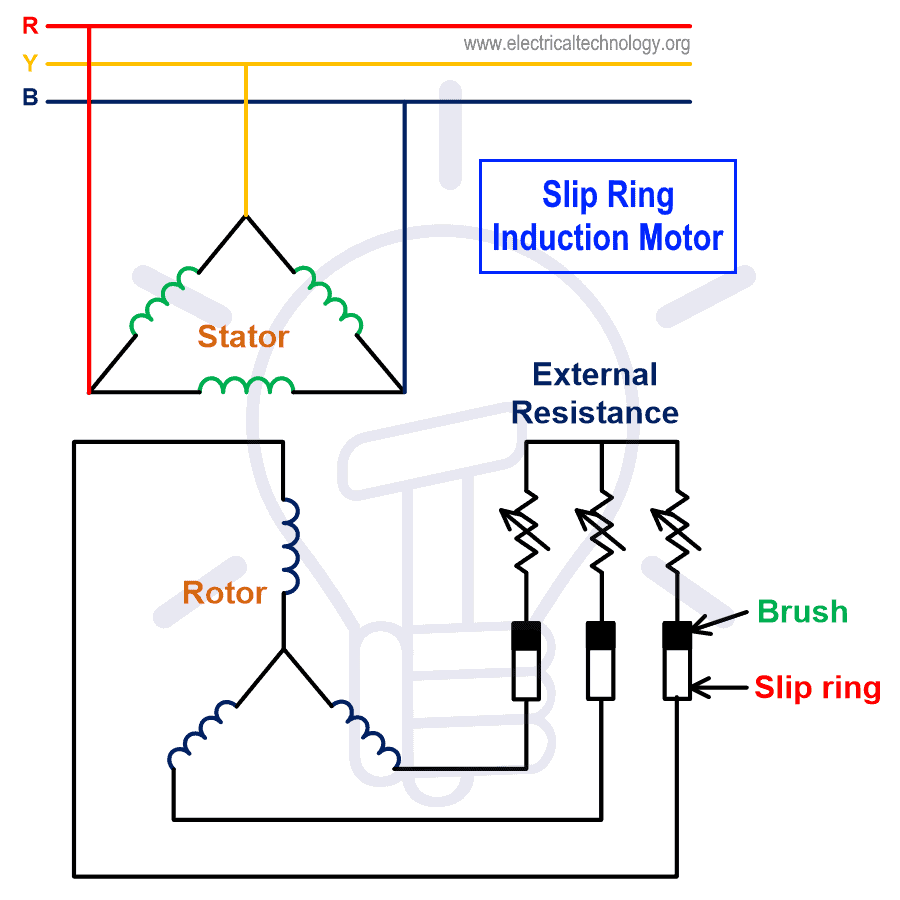
Working principle of three-phase induction motor
When three-phase power is connected to the stator winding, the stator winding will generate a rotating magnetic field (RMF), the speed of which is called synchronous speed (Ns). The stator windings usually overlap each other at 120° (electrical angle) to ensure the generation of a rotating magnetic field.
According to Faraday's law of electromagnetic induction, due to the rate of change of the rotating magnetic field (dΦ/dt), an electromotive force is induced in the rotor circuit. This electromotive force generates current in the rotor winding. Since the rotor circuit is a closed path, this induced electromotive force causes current to flow in the rotor circuit.
Since the current-carrying conductor generates a magnetic field, the current in the rotor generates a new magnetic field. There is a relative motion between the stator magnetic field and the rotor magnetic field, so the rotor begins to rotate to reduce this relative motion. In other words, the rotor tries to "catch" the rotating magnetic field of the stator and thus begins to rotate.
The direction of rotation is determined by Lenz's law, and the direction of the motor's rotor is consistent with the direction of the rotating magnetic field generated by the stator. Since the current in the rotor is generated by induction, this motor is called an induction motor.
However, the actual speed of the rotor is always slightly lower than the synchronous speed. Although the rotor tries to keep up with the stator's rotating magnetic field, it cannot completely "catch" it, so its speed is always lower than the synchronous speed. The synchronous speed depends on the power supply frequency and the number of poles of the motor. The difference between the speed and the synchronous speed is called slip.
Advantages of 3-Φ Induction Motors
Simple and strong structure: The motor has a simple design, a solid structure and strong durability.
Simple working principle: The working principle of the motor is easy to understand and easy to operate.
Widely adaptable to various environments: It can operate stably under various environmental conditions.
High efficiency: The motor has high efficiency and can effectively convert electrical energy into mechanical energy.
Low maintenance: Compared with other types of motors, induction motors require less maintenance.
Single excitation design: As a single excitation motor, the induction motor only needs one power supply and does not require an external DC power supply for excitation like a synchronous motor.
Self-starting function: The motor has a self-starting feature and can start and operate normally without additional starting auxiliary equipment.
Low cost: The manufacturing and purchasing costs of the motor are relatively low.
Long life: The motor has a long service life and strong durability.
Small armature reaction: The armature reaction of the motor is small, which helps to operate stably.
Applications of Three-Phase Induction Motors
Induction motors are mainly used in industrial applications, especially those that do not require motor speed control.
Applications of Squirrel Cage Induction Motors
Squirrel Cage Induction Motors are suitable for various applications that do not require complex speed control, including:
Pumps and submersibles: for liquid delivery and extraction.
Pressing machines: for pressing and forming materials.
Lathes: for cutting and processing metals or other materials.
Grinding machines: for grinding and finishing workpieces.
Conveyor belts: for material transmission and handling.
Flour mills: for grinding and processing flour.
Compressors: for gas compression and delivery.
Other low-power machinery: for various low-power machinery and equipment.
Applications of Slip Ring Motors
Slip ring motors are mainly used in heavy-duty applications that require high starting torque, including:
Steel mills: for processing and production of steel.
Crane: for lifting and moving heavy objects.
Lifting equipment: for lifting and transporting materials.
Spindles: for machines with high-torque spindle drives.
Other heavy machinery: for heavy machine shops and other applications that require high starting torque.
Energy-saving three-phase induction motor parameters
| Performance indicators | Definition | Unit |
| Rated Power | The power that a motor can continuously output under rated operating conditions. Common rated power values include 0.75 kW, 1.5 kW, 5.5 kW, etc. | Kilowatts (kW) or Horsepower (HP) |
| Rated Voltage | The power supply voltage required for the motor to operate normally. For example, common rated voltages are 380V, 400V, 460V, etc. | Volt (V) |
| Rated Current | The current value of the motor under rated load. The current is related to the motor power, efficiency and voltage. | Ampere (A) |
| Synchronous Speed | The speed at which the stator magnetic field rotates when the motor is running at rated frequency. | Revolutions per minute (RPM) |
| Actual Speed | The actual speed of the motor under load is usually slightly lower than the synchronous speed. | Revolutions per minute (RPM) |
| Slip | The difference between the actual rotor speed and the synchronous speed. | Percentage (%) |
| Efficiency | The efficiency with which an electric motor converts electrical energy into mechanical energy | Percentage (%) |
| Power Factor | The power factor of a motor is the ratio of the actual power of the motor to the apparent power. Typically, the power factor ranges from 0.7 to 0.9, with a higher power factor indicating that the motor uses electrical energy more efficiently. | |
| Starting Torque | The maximum torque generated by the motor at starting. Generally, higher starting torque is suitable for heavy-load starting. | Newton-meter (Nm) or pound-foot (lb-ft) |
fAQ
Q:1.What are the energy saving methods for induction motor drive?
A:At no-load, the voltage to the induction motor is changed, in steps, from 20% to 100% of the rated voltage. At each voltage step, the motor is allowed to run for 15 minutes and various parameters, losses, power factor, speed and slip are measured. Based on the losses, the energy saving is calculated with equation (1).
Q:2.What is the highest efficiency of induction motors?
A:This intrinsic design characteristic limits the maximum efficiency of the induction motor to about 90- 93%. The maximum efficiency of an induction motor is 90 / 93% whereas that of a permanent magnet motor is at 97% plus.
Q:3.What is the condition for maximum efficiency in 3-phase induction motor?
A:Their maximum efficiency is usually near 75% of the full load [4]. Running the motors below 75% utilization tends to reduce their efficiencies [5]. Hence, oversizing the motors can impact on energy consumption costs. Proper sizing and selection of induction motors are a key to ensure a good performance and reliability.
Q:4.What are the methods to find out the efficiency of a three phase induction motor?
A:In induction motor efficiency can be calculated if we know the shaft power(i.e., mechanical power delivered by motor ) and input power. By calculating [p(mech)/p(in) ] we can find the efficiency of induction motor. Generally induction motor efficiency is about 87%.
Q:5.What are the four energy conservation techniques in induction motor?
A: (a) Improving power quality. (b) Motor survey. (c) Matching motor with loading. (d) Minimizing the idle and redundant running of motor.
Q:6.How to choose an energy-saving three-phase induction motor?
A:Energy efficiency rating: Choose a motor that meets or exceeds international energy efficiency standards such as IE3 or IE4.
Rated power: Choose a motor with the right power according to the actual load requirements.
Working environment: Consider the working environment conditions of the motor, such as temperature, humidity, and protection level, to ensure the suitability of the motor.
Manufacturer reputation: Choose products from well-known and reputable manufacturers to ensure quality and performance.
Maintenance requirements: Understand the maintenance requirements and service support of the motor to ensure its long-term stable operation.
Hot Tags: energy efficient 3-phase induction motor, China energy efficient 3-phase induction motor manufacturers, suppliers, factory, induction motor, ac induction machine, ac induction motor
You Might Also Like


Send Inquiry